

2027 Multi-Location Signage: Standardize Before You Scale

WHO SHOULD READ THIS
Operations leaders, marketing teams, facility managers, franchise groups, and multi-location businesses preparing to open, refresh, or roll out signage across several locations in 2027.
Quick Answer
Multi-location signage should standardize the brand decisions that need to repeat while leaving room for each physical site to adapt.
The goal is not to make every location identical.
It is to stop every location from starting over.
A useful planning sequence is: STANDARDIZE → ADAPT → APPROVE → ROLLOUT
Standardize the core brand logic.
Adapt the execution to the real site.
Approve each location in context.
Then document what should carry forward into the next rollout.
The Problem Starts When Every Location Becomes a New Project
A business may have a clear brand and still end up with inconsistent physical locations.
Location one is planned by one team.
Location two uses a previous file but changes the size.
Location three has a different building and solves the problem another way.
By location five, the signs may all contain the same logo but no longer feel like part of one system.
The opposite can also happen.
A company tries to copy the first location exactly, even when the next site has a different facade, entrance, viewing condition, interior layout, or customer journey.
Neither extreme scales well.
A repeatable signage program needs standards without pretending every building is the same.
1. STANDARDIZE: Decide What Should Not Be Reinvented
Before the next site begins, define the decisions that should carry from one location to another.
That may include:
- Approved logo use
- Core brand colors
- Primary versus supporting sign hierarchy
- The role of the main exterior identity
- The role of the main interior brand anchor
- How directional and informational signs relate to the brand
- What information belongs on primary versus secondary signs
- Which visual references represent the brand correctly
These standards create a starting point.
They should answer: “What should feel familiar every time a customer enters one of our locations?”
Notice that this is different from deciding that every location needs the same sign dimensions or the same number of signs.
Brand consistency is about recognizable logic.
It is not about forcing every property into the same physical template.
That is also why signs can stay connected without all looking identical.

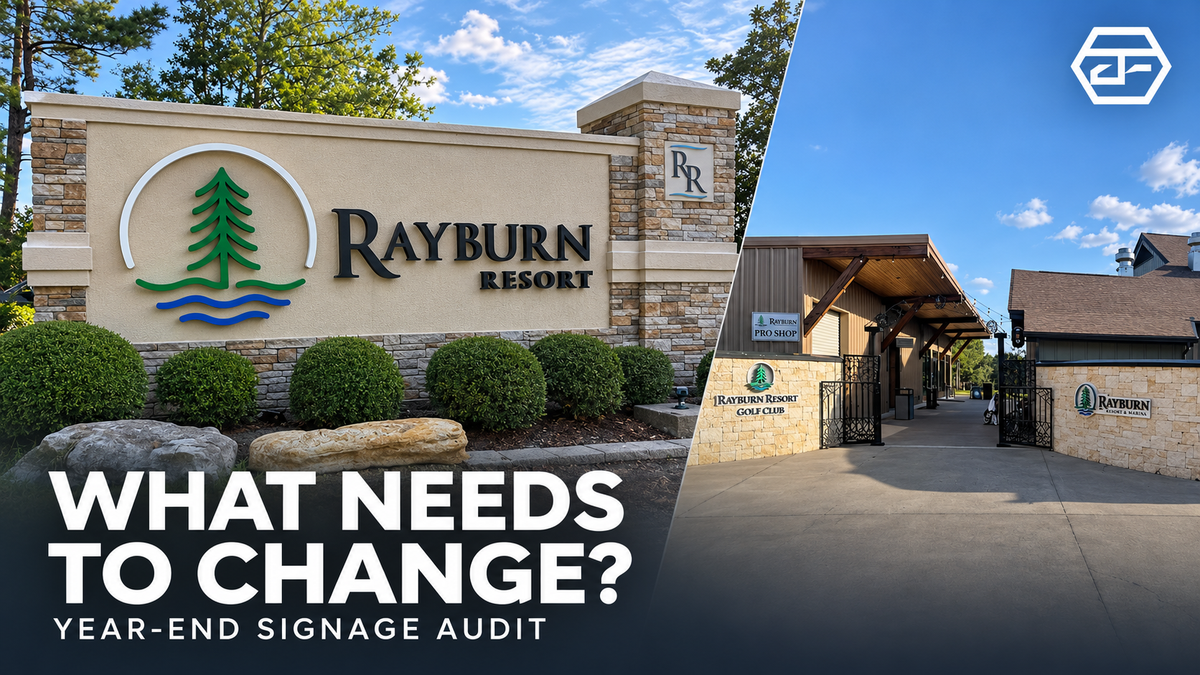
Consistent brand signage shown across two different business locations
Opening several locations in 2027?
Send AFCULTURES your brand files, photos of an existing location, and the next sites being planned. We can help identify which signage decisions should become repeatable standards before each location is developed separately.
2. ADAPT: Let the Site Change the Execution
Once the brand standards are clear, review each location on its own terms.
Location A may have a wide storefront.
Location B may sit inside a shared commercial property.
Location C may have a recessed entrance.
Location D may need a stronger interior arrival moment because the exterior already does the identification work clearly.
For each site, review:
- How customers approach the property
- Where the entrance is located
- Available facade or wall space
- What surrounds the proposed sign
- Which touchpoints actually need signage
- Where the brand should feel strongest
The International Sign Association notes that on-premise signs are not fully standardized across locations. Even when a business wants similar signage at several sites, local requirements and site-specific visibility conditions can require design changes. Its position on on-premise sign standardization reinforces why a rollout should preserve brand intent while still reviewing each location individually.
The useful principle is: Standardize the decision. Adapt the physical solution.

A signage standard should guide the site, not ignore the architecture, entrance, and way customers actually approach it.
3. APPROVE: Review Every Location in Context
A rollout becomes risky when approval happens only at the artwork level.
The logo may be correct.
The colors may be correct.
The sign may even match the standard.
But does it make sense on this building?
For every location, review the proposed signage against:
- The full facade or wall
- The normal viewing position
- The entrance
- Nearby architectural elements
- Other signs already in the space
- The customer journey through the property
A standard should make approvals faster, not eliminate site review.
Before a location moves forward, it should be clear what is fixed by the brand standard and what has been adapted for that site.
If the project is already approaching approval, use the checklist on what should be finalized before approving a sign to catch unresolved decisions before production.
4. ROLLOUT: Document What You Learn From Every Site
A signage standard should improve as the rollout progresses.
After each location, document what should become useful for the next one.
That might include:
- Approved reference views
- Successful primary sign hierarchy
- Examples of acceptable site adaptations
- Which customer touchpoints actually needed signage
- Which information was unnecessary
- What the next location should prepare earlier
The goal is to create a feedback loop: STANDARD → SITE → APPROVAL → LEARNING → NEXT SITE
That prevents the company from solving the same problem repeatedly.
It also makes it easier for internal teams, vendors, and location stakeholders to understand what the brand is trying to protect.

Each completed location should make the next rollout easier by creating a clearer reference for what stays consistent and what can adapt.
Already planning several locations for 2027?
Send AFCULTURES your current signage references, brand files, location photos, and rollout priorities. We can help organize the repeatable brand decisions separately from the site-specific decisions each property still needs.
What Should Be Standardized and What Should Adapt?
| Standardize Across Locations | Review at Each Location |
|---|---|
| Logo and core brand identity | Available sign area |
| Primary sign hierarchy | Scale and placement |
| Overall visual relationship | Building architecture |
| Roles of primary and supporting signs | Customer approach and entrance |
| Approved brand references | Number of signs actually needed |
| Information hierarchy | Site-specific operational needs |
The left side protects the brand.
The right side protects the location from being forced into a solution that does not fit.
Do Not Turn the Signage Standard Into a Product List
A weak rollout standard often becomes a list like:
- One exterior sign
- One reception sign
- Two directional signs
- One feature wall
That may work for one building and fail at the next.
A better standard defines the job first.
For example:
PRIMARY IDENTITY
Every location needs a clear primary brand moment customers can recognize.
ARRIVAL CONFIRMATION
Add only when the entrance is not already obvious.
NAVIGATION
Use where the property creates a real decision point.
INTERIOR BRAND ANCHOR
Choose the strongest customer-facing moment rather than automatically repeating the same wall treatment.
This way, the standard protects the customer experience instead of forcing the same purchase list onto every site.
If the locations vary significantly in complexity, it may also help to review whether each property needs one sign or a broader signage system.
A 6-Question Multi-Location Rollout Check
Before the next location moves forward, ask:
- What must remain recognizable across every site?
- What is different about this building or customer approach?
- Which sign should carry the strongest brand presence here?
- Which supporting signs solve an actual site-specific problem?
- Has the proposed signage been reviewed in the real space?
- What should we document from this location for the next rollout?
If the team cannot distinguish the standard from the site-specific decisions, the rollout system is probably not clear enough yet.
Frequently Asked Questions
Should every location use exactly the same signs?
No. Core brand identity and signage hierarchy can remain consistent while scale, placement, supporting signs, and other site-specific decisions adapt to the property.
When should a business create signage standards?
Ideally before multiple locations begin making the same decisions independently. A standard becomes especially valuable when the business is opening, renovating, rebranding, or updating several sites within the same rollout period.
What should a new location provide before signage planning starts?
Start with brand files, wide exterior and interior photos, the customer approach, entrance views, proposed sign areas, known site requirements, and the target opening or rollout timeline.
Scale the System, Not the Same Sign
A strong multi-location brand should become easier to recognize as it grows.
That does not mean every building should look identical.
Standardize what makes the brand recognizable. Adapt what the site requires. Review every location in context. Then carry what you learn into the next rollout.
Building a multi-location signage program for 2027?
Send AFCULTURES your brand files, existing signage references, upcoming locations, site photos, and rollout timeline. We can help organize a signage approach that stays consistent without treating every building as the same project.