

Q1 2027 Signage Planning: What to Finalize in November
WHO SHOULD READ THIS
Business owners, operations teams, marketing leaders, and multi-location brands preparing for a Q1 2027 opening, renovation, relocation, rebrand, or signage rollout.
Quick Answer
If your business is opening, renovating, or rolling out a new location in Q1 2027, November is a good time to stop treating signage as a future detail and start locking the information the project will actually depend on.
You do not need every final production decision today.
But four things should become clear:
SPACE → SCOPE → APPROVAL → READY
Understand the real space.
Define what the signage actually needs to solve.
Identify the approvals and decisions that still need to happen.
Then prepare the files, photos, locations, and timeline needed to move the project forward.
Why November Matters for a Q1 Opening
A January, February, or March opening can still feel far away in November.
That is exactly why signage is easy to leave until later.
The lease is being finalized.
The buildout is moving.
Furniture, equipment, branding, staffing, and operations all feel more urgent.
Then the space becomes nearly ready and someone asks:
“What are we doing about the signs?”
At that point, the problem is rarely just choosing a sign style.
The team may still need to confirm the wall, entrance, dimensions, customer approach, landlord requirements, project scope, or which locations actually need signage.
For a Q1 opening, November is useful because there is still time to resolve those planning questions before signage becomes another last-minute dependency.
1. SPACE: Confirm Where the Signage Actually Has to Work
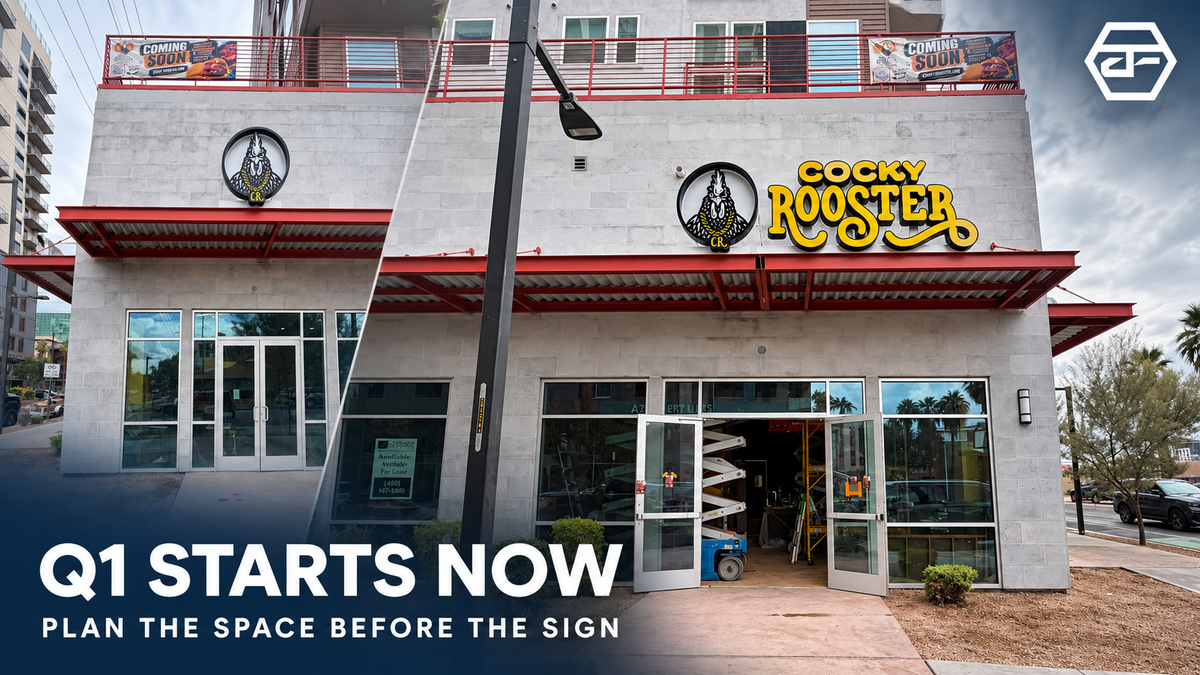
Start with the real location, not the logo file.
For each important sign area, collect wide photos that show the surrounding environment.
That may include:
- The full storefront or building facade
- The normal customer approach
- The main entrance
- Reception or check-in
- Important interior zones
- Walls being considered for brand signage
A tight photo of an empty wall is usually not enough to understand the role that sign needs to play.
The same logo can feel completely different depending on the wall proportions, viewing distance, neighboring elements, entrance location, and architecture around it.
That is why AFCULTURES recommends planning from the real space before individual signs are developed.
If the location has not been reviewed yet, our guide to why site context matters before sign production explains what should be understood before fabrication begins.

Start with the real environment. A sign should be planned around the space customers will actually see.
Planning a Q1 opening but still deciding where the signage belongs?
Send AFCULTURES your logo, project location, exterior photos, entrance view, and the key interior spaces. We can help review the physical context before you start choosing individual signs.
2. SCOPE: Decide What Problems the Signage Needs to Solve
Once the space is clear, do not immediately create a shopping list of signs.
First define the jobs.
A new location may need signage to help customers:
FIND → ENTER → MOVE → EXPERIENCE
Some signs establish the business from outside.
Some confirm the correct entrance.
Some help people move through a larger facility.
Others create a strong brand moment once the customer is inside.
Not every location needs all four layers.
A simple office may need one primary sign.
A large gym, restaurant, clinic, showroom, headquarters, or multi-use facility may need several coordinated touchpoints.
The goal in November should be to know the scope well enough that the team is not discovering new signage needs days before opening.
If several customer moments need signage, review whether the project is really one sign or a connected signage system.

Define the customer moments first, then decide whether the location needs one primary sign or a coordinated signage system.
3. APPROVAL: Identify What Can Still Hold the Project Up
A sign can be visually approved while important project questions are still unresolved.
Before the year moves further into its final months, identify who still needs to make a decision.
Depending on the project, that may include:
- The business owner or internal brand team
- Operations or facilities
- The landlord or property manager
- The design or construction team
- The sign partner
- Other project stakeholders
You do not need to invent requirements that do not apply to the project.
But you should know which approvals are actually relevant before a final sign direction is treated as ready.
The International Sign Association recommends discussing the project location, building conditions, design needs, installation, and other project requirements when evaluating a sign partner. Its questions to ask a potential sign partner are useful when defining those responsibilities early.
This is especially important when several teams are working toward the same opening date.
A decision that seems small to one team can become a dependency for another.
4. READY: Prepare the Inputs Before the Project Becomes Urgent
By the end of the planning stage, the sign team should not have to reconstruct the project from scattered messages.
Prepare a simple project package.
At minimum, include:
- Logo or approved brand files
- Project city and state
- Wide exterior and interior photos
- The proposed sign locations
- Approximate available space or dimensions if known
- Which location or wall is the priority
- Opening, renovation, or launch timeline
- Any existing signage being kept or replaced
- Known landlord or property requirements
You do not need to know the answer to every fabrication question.
You do need enough information for the project to be evaluated in context.
Our checklist on what to prepare before ordering a custom sign can help organize those inputs.
Already have a Q1 opening date on the calendar?
Send AFCULTURES your project location, logo, site photos, proposed sign areas, and target opening date. We can help identify what is already ready and what still needs to be clarified before the signage moves forward.
What Should Be Clear by the End of November?
| Question | What You Should Know |
|---|---|
| Where? | The real exterior, entrance, and key interior locations |
| Why? | What each important sign needs to help customers do |
| How much? | Whether the project needs one sign or several coordinated touchpoints |
| Who? | Which stakeholders still need to review or approve the direction |
| When? | The opening, renovation, launch, or rollout date the project is working toward |
| What is ready? | The brand files, photos, locations, and project information already available |
The goal is not to finalize every detail by an arbitrary date.
It is to remove the questions that become expensive or stressful when they are discovered too late.
Do Not Approve a Sign Just Because the Mockup Looks Finished
There is an important difference between a polished mockup and a resolved project.
Before final approval, check that the sign direction still makes sense in the actual environment.
Review:
- Scale in relation to the wall
- Placement in the full space
- The normal viewing position
- Surrounding architecture
- The role of nearby signs
- The information that actually needs to be communicated
If the project is reaching approval stage, use our guide to what should be finalized before you approve a sign.
A 6-Question November Check for a Q1 Signage Project
Before November ends, ask:
- Do we have wide photos of the actual space?
- Do we know which customer moments actually need signage?
- Do we know the primary sign or brand anchor?
- Do we know who still needs to approve the direction?
- Are our brand files and project information organized?
- Is the sign team working toward the same Q1 date as everyone else?
If several answers are still unclear, that is what should be resolved next.
Frequently Asked Questions
Is November too early to plan signage for a Q1 2027 opening?
No. You do not need every detail finalized, but the project space, main signage needs, approval path, and target opening timeline should already be becoming clear.
What if the renovation is not finished yet?
You can still start with plans, current site photos, proposed sign areas, brand files, and the intended customer journey. The important point is to identify what is known and what still needs to be confirmed.
Should we choose the sign type before the space is finalized?
Usually it is more useful to understand the location, viewing conditions, brand role, and customer need first. The sign direction can then be evaluated against the real space instead of being chosen in isolation.
Do Not Let the Signage Become the Last Q1 Decision
A Q1 opening is not only a construction deadline.
It is the moment customers begin experiencing the new location.
Use November to understand the space, define the signage scope, identify the approvals, and prepare the project inputs.
Then when the location moves closer to opening, the signage is already part of the plan—not another unfinished decision waiting at the end.
Opening, renovating, or rolling out a location in Q1 2027?
Send AFCULTURES your logo, project location, exterior and interior photos, proposed sign areas, and target opening date. We can help review the signage plan before the project becomes a last-minute rush.