


Project Breakdown: When a Custom Sign Needs More Than a Front Mockup
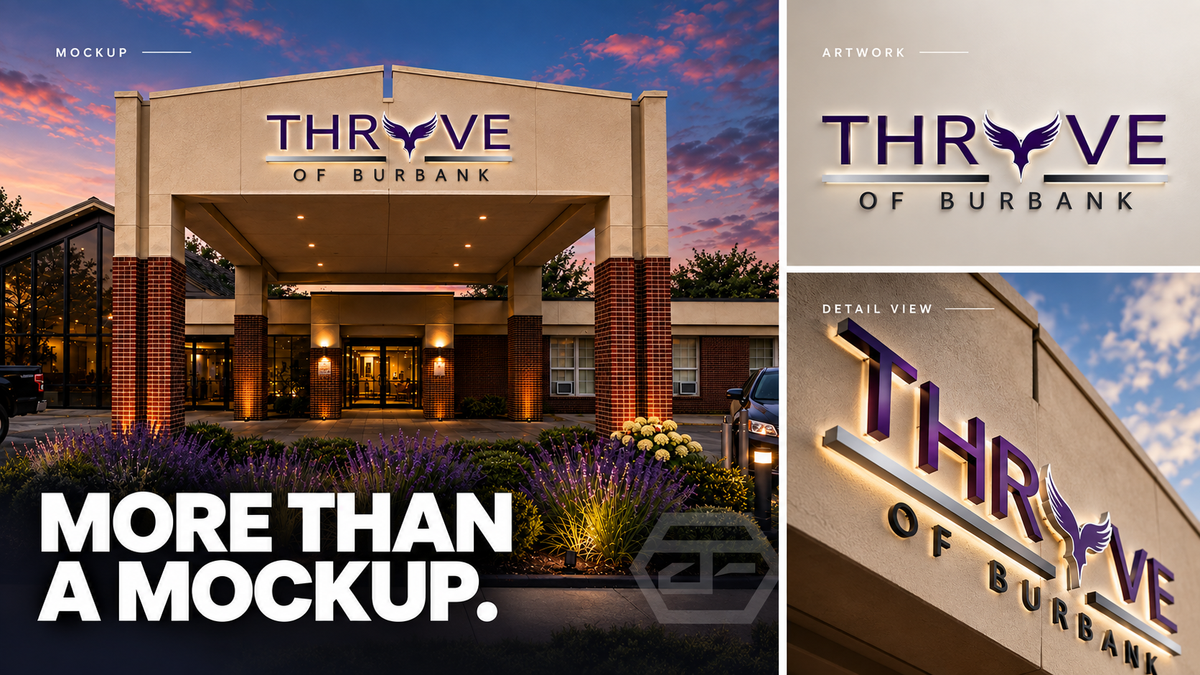
WHO SHOULD READ THIS
Business owners, project managers, designers, and sign professionals reviewing a custom sign that is difficult to understand from a front-facing artwork or wall mockup alone.
Quick Answer
A front mockup can show what a sign looks like from the front and where it may sit in the space. But for a more custom project, that may not be enough to approve with confidence.
Depending on the project, the review may also need:
- A real-space wall visualization
- A front view
- A side view
- A closer explanation of layers or physical form
The goal is not to create more drawings.
It is to answer the questions the client still cannot see.
SHOW THE SPACE → SHOW THE FACE → SHOW THE PROFILE → EXPLAIN WHAT STILL ISN'T CLEAR
The Project Challenge: A Logo Is Still Flat
On a recent custom-sign project reviewed with an AFCULTURES partner, the end client was highly detail-oriented.
The client wanted more than a quote. They wanted to understand what they were buying before moving forward.
The process included a live conversation, reviewing materials in person, and even placing full-size artwork on the wall to understand scale. The partner later noted that visual explanations and technical drawings helped build enough confidence for the project to move forward.
That highlights a simple problem with custom signage:
A logo shows the brand. It does not automatically show the physical result.
If the sign has depth, multiple layers, a specific profile, or another feature that changes how it will feel in the real space, one front image may leave important questions unanswered.

The wall mockup answers the first question: how will the proposed sign sit in the real space?
Different Visuals Answer Different Questions
Not every project needs the same approval package.
| Visual | Question It Helps Answer |
|---|---|
| Wall mockup | Where will the sign sit in the real space? |
| Front view | What will the customer see head-on? |
| Side view | How will the sign relate to the wall from an angle? |
| Additional detail view | What part of the physical form still needs explanation? |
The partner feedback from this project was especially useful here: front and side views were treated as core communication tools, while an exploded view was valuable when the project itself was complex enough to need more explanation.
That leads to a better rule: Use the simplest visual that answers the decision.
A straightforward sign may only need a clear wall mockup.
A more custom sign may need another view before everyone can confidently approve the same thing.

A front view explains the face of the sign. A side view can answer questions that disappear when everything is viewed head-on.
A Mockup Shows Appearance. Another View Can Show What the Mockup Hides.
A wall visualization is still one of the most useful early decision tools.
It helps answer:
- Does the sign fit the wall?
- Does the scale feel right?
- Is the placement balanced?
- Does it work with the surrounding space?
AFCULTURES already uses this real-space approach because a sign that looks balanced on a blank screen may feel very different once it sits next to doors, furniture, architecture, and other visual elements.
But a wall mockup usually emphasizes appearance.
When the remaining question is about profile, depth, layering, or how the proposed object should be understood from another angle, another view may communicate more clearly than adding another paragraph of explanation.
Do Not Over-Explain a Simple Project
More documentation is not always better.
One important takeaway from the partner workflow was that different projects should receive different levels of visual explanation.
A simple project may need: Wall context + front view
A more customized project may need: Wall context + front view + side view
A project with a physical feature that is still difficult to understand may benefit from: An additional detail or exploded explanation
The mistake would be using the heaviest presentation for every quote.
That wastes time for the project team and can overwhelm a client who only needed one question answered.
The objective is clarity proportional to complexity.
Why This Matters Before Production
The partner described these visuals as more than production documents.
They became a sales communication tool.
The drawings helped reduce questions and helped the client understand more clearly what they were approving.
That matters because approval works better when the people involved are imagining the same result.
Before moving forward, the client should be able to understand:
- Where the sign will live
- What it will look like from the primary view
- Whether another angle changes how the sign is understood
- Which parts of the direction are already approved
- What still needs a decision
Once those points are clear, the project can move into production with fewer assumptions.
Frequently Asked Questions
Does every custom sign need a 3D or exploded drawing?
No. The level of visual documentation should match the complexity of the project and the decisions the client needs to make.
Is a wall mockup enough to approve a sign?
Sometimes. A wall mockup can be enough when the sign is straightforward and the remaining questions are mainly about scale and placement. More customized projects may need additional views.
What should I understand before approving a custom sign?
You should understand where it will be placed, its overall appearance, its relationship to the real space, and any physical features that materially affect what you are approving.
Show the Client What They Are Actually Approving
A custom sign should become clearer as the project moves forward—not harder to imagine.
Start with the real space.
Show the primary appearance.
Then add another view only when it answers a question the first one cannot.
Working on a custom sign that is difficult to explain from a logo or front mockup alone?
Send AFCULTURES your artwork, wall photo, dimensions, and the visual direction already approved. We can help determine what the client needs to see next before the project moves into production.


