


How To Know Your Custom Sign Is Being Built Right
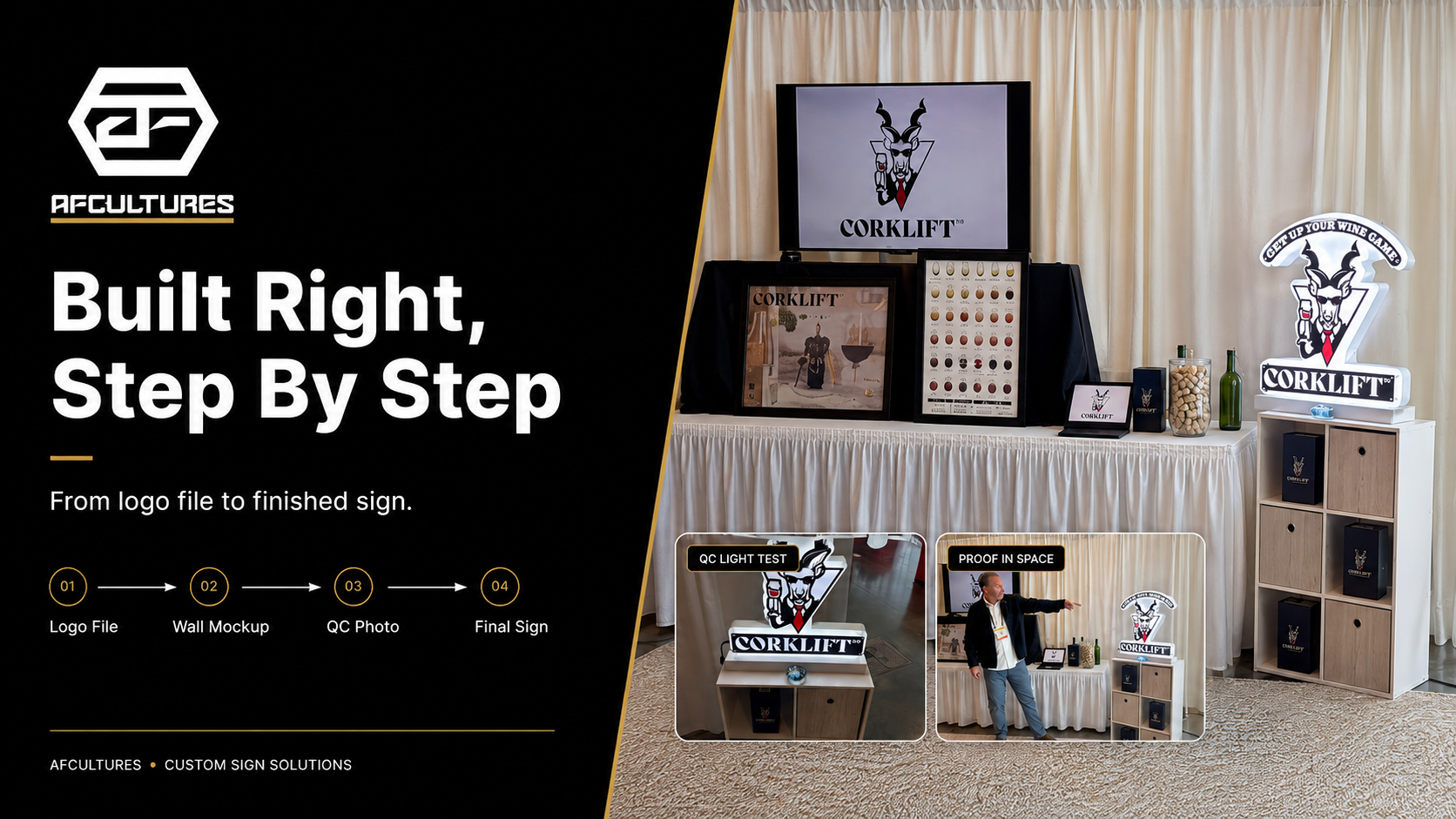
A custom sign should not feel like a black box.
After you approve a quote or mockup, you should not be left wondering what is happening, whether the size is right, whether the materials match the plan, or whether the sign will look right once it reaches the wall.
A strong custom sign process should show proof at each important step.
That proof can include a reviewed logo file, a wall or storefront mockup, material and lighting direction, production progress, quality control photos, packing details, and installation planning.
This matters because a business sign is not only a decorative object. The International Sign Association notes that sign legibility, viewing enjoyment, information, quality, appropriate scale, and uniqueness can affect how well a sign performs for a business.
Customers also form impressions from signage. Sign research has found that consumers can learn and assume things about a business based on its sign.
That is why the process behind the sign matters.
A better process creates a better final sign.
Quick Answer: What Proof Should You Expect During A Custom Sign Project?
Before and during production, a custom sign project should give you clarity on:
-
Logo and file readiness
-
Wall or storefront context
-
Sign size and placement
-
Material and lighting direction
-
Production status
-
Quality control checks
-
Packing or shipping readiness
-
Installation or site planning
You do not need to manage every technical detail yourself.
But you should know what has been checked before the sign is built, shipped, or installed.

See Your Sign Before Production Starts
Send your logo and wall or storefront photo. AFCULTURES can help visualize your sign in the real space before production, so you can review size, placement, material, and lighting direction earlier.
1. Proof Starts With The Logo File
The first proof point is the logo file.
A sign team should review whether the logo can become a physical sign clearly and cleanly. A logo that works on a website, business card, or social media profile may still need technical review before fabrication.
The team may need to check:
-
Small text
-
Icon details
-
Color breaks
-
Gradients or shadows
-
Stroke width
-
Whether the logo can be scaled
-
Whether the sign should use only the main logo or simplified artwork
This does not mean changing the brand.
It means translating the brand into something buildable.
If the artwork has thin lines, tiny taglines, or complex details, those details may not work well at every size or material. A good process should catch that early, before fabrication begins.
2. The Sign Should Be Reviewed In The Real Space
A sign should not be approved only on a blank white background.
It should be reviewed against the actual wall, storefront, lobby, reception area, or installation location.
The Sign Research Foundation notes that viewing distance, size, and location are important factors when deciding sign placement. In real life, customers may see the sign from a sidewalk, parking lot, street, hallway, entrance, or across a room.
That is why a real-space mockup matters.
A wall or storefront mockup helps check:
-
Whether the sign feels too small or too large
-
Whether the background gives enough contrast
-
Whether the placement feels balanced
-
Whether doors, windows, columns, or furniture affect the view
-
Whether the sign is visible from the right customer path
-
Whether lighting should be added or adjusted
A good mockup is not just a pretty preview.
It is a decision tool.
Want To Check If Your Sign Fits The Space?
AFCULTURES can review your logo, wall photo, viewing distance, and preferred sign direction before production starts.
3. Material And Lighting Should Be Confirmed Before Fabrication
A custom sign is not only about shape.
Material and lighting affect the final look, cost, timeline, durability, installation, and long-term performance.
Before production, you should understand the direction clearly:
| Decision | Why It Matters |
|---|---|
| Metal, acrylic, or mixed material | Affects finish, weight, durability, and appearance |
| Illuminated or non-illuminated | Affects visibility, wiring, cost, and installation |
| Halo-lit, front-lit, or another lighting style | Affects mood, brightness, and wall effect |
| Indoor or outdoor use | Affects material, weather exposure, and build requirements |
| Mounting method | Affects installation, wall prep, and final appearance |
For illuminated signs, lighting should not be treated as an afterthought.
The International Sign Association identifies size, sign angle, location, luminance, and contrast as key factors in sign visibility. That means lighting should be reviewed together with the real wall, viewing distance, and background conditions.
If the sign is electric and installed in the U.S., NEC Article 600 and UL 48 may also become relevant depending on the project and local requirements.
4. Production Proof Builds Confidence
Production proof is where trust becomes visible.
Once fabrication begins, progress photos can help customers understand that the sign is moving from idea to real object.
Useful production proof may include:
-
Material preparation
-
Letter cutting or shaping
-
Metal or acrylic details
-
Paint or finish check
-
LED placement
-
Wiring or back detail
-
Assembly progress
-
Lighting test
-
Final sign before packing
These photos are not only for social media.
They help confirm that the sign is being built according to the approved direction.
For trade partners, production proof is even more important because they may need to communicate progress to their own clients while keeping the fabrication partner behind the scenes.
A sign team that can show process clearly reduces uncertainty.
5. QC Should Happen Before The Sign Leaves The Workshop
Quality control should not be one final glance before shipping.
It should be a step that checks the sign against the project plan before the sign leaves the workshop.
Before packing, QC may include checking:
-
Letter shape and alignment
-
Surface finish
-
Color consistency
-
Face and return details
-
LED brightness and consistency
-
Mounting points
-
Accessories
-
Power supply or wiring components, if applicable
-
Final photos
-
Packing readiness
A sign can look fine from far away but still have issues in finish, alignment, lighting, or hardware.
That is why QC photos and clear communication matter.
They help catch questions before the sign is installed in the customer’s space.

6. Packing And Installation Planning Protect The Final Result
A sign is not finished just because fabrication is complete.
It still has to reach the site safely and be installed correctly.
Packing and installation planning may include:
-
Protecting painted or polished surfaces
-
Separating fragile components
-
Labeling accessories
-
Including mounting templates, if needed
-
Confirming shipping method
-
Checking installation surface
-
Reviewing power access for illuminated signs
-
Checking landlord, property, or city requirements for outdoor signs
This is where planning, production, and installation meet.
A strong process should protect the final sign until it is on the wall, not only until it leaves the workshop.
Common Mistakes To Avoid
Before approving a custom sign project, avoid these mistakes:
-
Approving only a logo mockup without wall context
-
Choosing size without checking viewing distance
-
Choosing lighting without checking wall color and background
-
Not confirming indoor vs outdoor use
-
Not asking what proof or QC photos will be provided
-
Waiting until installation day to think about power access
-
Forgetting landlord or property requirements
-
Treating packing as an afterthought
Most sign problems are easier to prevent before production than fix after installation.
What To Send Before Starting A Custom Sign Project
To make the process clearer, prepare:
| What To Send | Why It Matters |
|---|---|
| Logo file | Helps review artwork and production feasibility |
| Wall or storefront photo | Helps check scale, placement, and background |
| Approximate sign size or wall width | Helps estimate proportion and readability |
| Indoor or outdoor location | Affects material, lighting, and installation planning |
| Preferred material or style | Helps guide the build direction |
| Lighting preference | Helps plan visibility and wiring |
| Project city/state | Helps with outdoor planning and approval considerations |
| Desired timeline | Helps plan mockup, production, shipping, and installation |
You do not need to know every answer before reaching out.
But the more context you share, the easier it is to build the right sign with fewer assumptions.
Ready To Build With More Clarity?
Send your logo, wall or storefront photo, project location, and timeline. AFCULTURES can help turn your idea into a buildable sign direction and keep the process clearer before production starts.

Frequently Asked Questions
What proof should I ask for before my custom sign is built?
Ask for a reviewed mockup, size and placement confirmation, material and lighting direction, and any important site or installation notes before production begins.
Why should I send a wall or storefront photo?
A wall or storefront photo helps the sign team understand the real environment, including scale, background color, viewing distance, obstacles, and placement options.
Should I ask for production or QC photos?
Yes. Production and QC photos can help confirm finish, lighting, assembly, mounting details, and packing readiness before the sign ships or gets installed.
Does every sign project need installation planning?
Not every small indoor sign needs complex installation planning. But outdoor signs, illuminated signs, large signs, difficult walls, or projects with landlord and permit requirements should be reviewed more carefully before production.


