


Halo-Lit vs Front-Lit Signs: Which Lighting Style Fits Your Business?
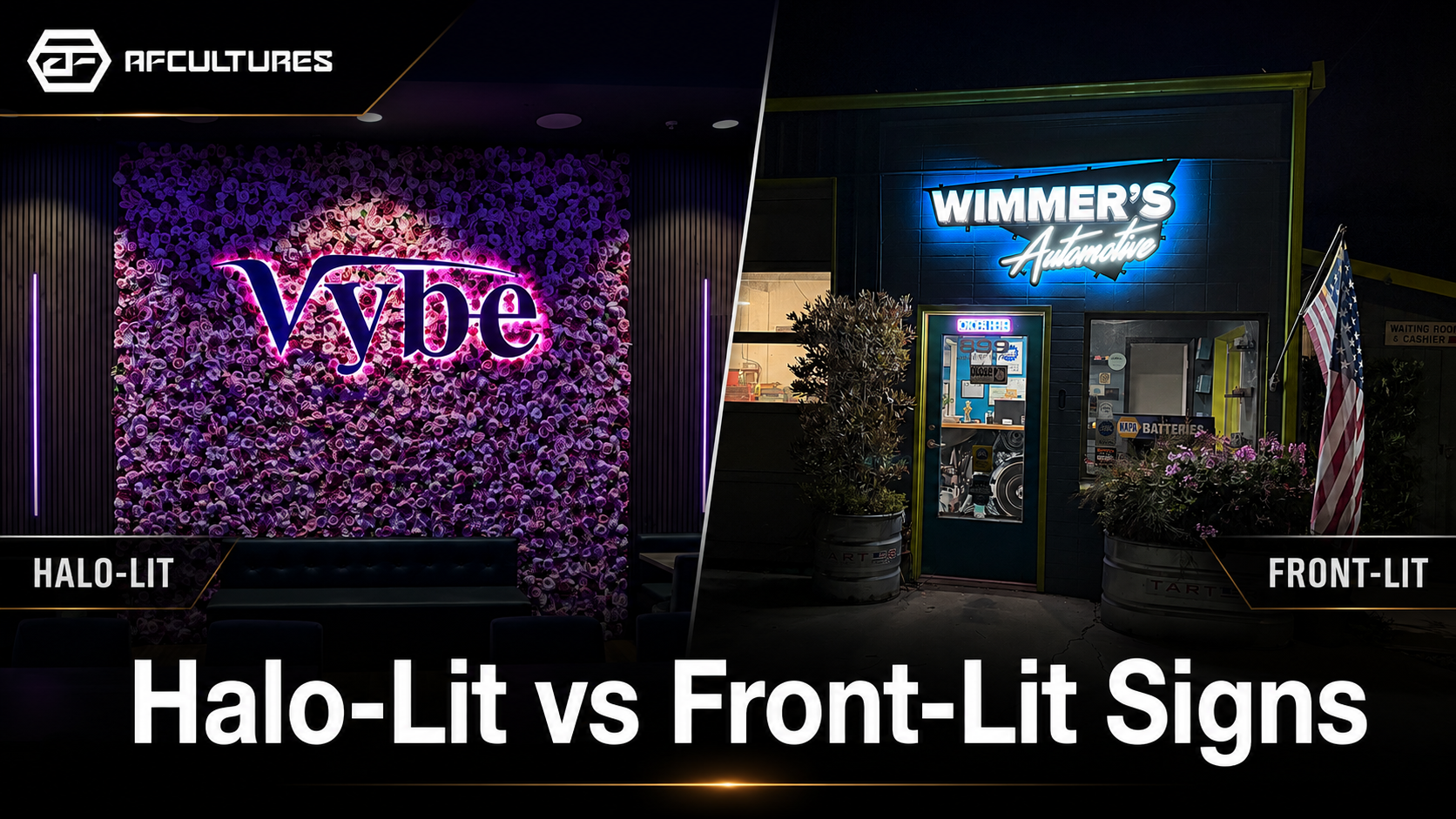
Lighting can completely change how a business sign feels.
The same logo can look soft, bold, premium, bright, subtle, or high-impact depending on how the sign is illuminated.
That is why choosing between halo-lit and front-lit signs is not just a style decision. It affects visibility, readability, brand presence, wall appearance, and how the sign performs after dark.
The International Sign Association identifies size, sign angle, location, luminance, and contrast as important factors in sign visibility. That means lighting should be planned with the real storefront or wall in mind, not selected from a close-up product photo alone.
This guide explains the difference between halo-lit and front-lit signs, when each option works best, and what to prepare before requesting a recommendation.
Quick Answer: What Is The Difference Between Halo-Lit And Front-Lit Signs?

Halo-lit signs, also called backlit or reverse-lit signs, direct light toward the wall behind the letters or logo. This creates a glow around the sign shape.
Front-lit signs direct light forward through the face of the letters. This creates a brighter, more direct lighting effect.
| Lighting Style | Main Effect | Often Best For |
|---|---|---|
| Halo-lit / backlit | Soft glow behind the sign | Premium storefronts, studios, offices, refined interiors |
| Front-lit / face-lit | Bright light through the sign face | Busy storefronts, plazas, restaurants, gyms, retail |
| Combination-lit | Light from both front and back | Businesses that want visibility and depth |
The best choice depends on your brand style, viewing distance, wall surface, brightness needs, and installation location.
Not Sure Which Lighting Style Fits Your Sign?
Send your logo, wall or storefront photo, and installation location. AFCULTURES can help review whether halo-lit, front-lit, or another illuminated sign style fits your space before production starts.
What Are Halo-Lit Signs?

Halo-lit signs create light from behind the letters or logo.
In channel-letter terminology, halo-lit signs are also often called backlit or reverse-lit signs. The letters are usually mounted slightly away from the wall, allowing the light to reflect backward and create a glow around the sign shape.
This lighting style often feels softer and more dimensional than direct front lighting.
Halo-lit signs can work well for:
-
Premium storefronts
-
Salons and beauty studios
-
Professional offices
-
Clinics
-
Boutique retail spaces
-
Restaurants or cafés with a warmer atmosphere
-
Lobby and reception walls
-
Brands that want a refined, less aggressive look
The wall matters for halo-lit signs.
A clean wall surface can help the glow look more even. Wall color, texture, finish, and surrounding light can all affect how the halo appears.
Halo-lit signs are not only about brightness. They are about mood, depth, and the way the brand feels in the real space.
What Are Front-Lit Signs?
Front-lit signs illuminate through the front face of the letters or sign structure.
This creates a brighter and more direct effect because the sign face becomes the main visible light source.
Front-lit signs often work well for:
-
Storefronts in busy plazas
-
Restaurants
-
Gyms
-
Retail stores
-
Service businesses near parking lots
-
Businesses that need stronger nighttime visibility
-
Locations where customers need to read the sign from farther away
Front-lit signs are often chosen when direct readability matters more than a soft lighting mood.
That does not mean front-lit signs cannot look premium. They can. But the design has to be balanced carefully.
Face color, letter size, LED brightness, viewing distance, and wall background all affect the final result. A front-lit sign that is too bright can feel harsh. A well-planned front-lit sign can feel clear, confident, and easy to recognize.
Halo-Lit vs Front-Lit Signs: Quick Comparison
| Factor | Halo-Lit Signs | Front-Lit Signs |
|---|---|---|
| Lighting direction | Light reflects backward onto the wall | Light shines forward through the face |
| Visual feel | Softer, refined, dimensional | Brighter, direct, high-visibility |
| Best for | Premium spaces, studios, offices, refined storefronts | Busy streets, plazas, restaurants, gyms, retail |
| Wall dependency | Higher — wall color and texture affect glow | Moderate — face visibility matters more |
| Readability from distance | Good when sized and contrasted well | Often stronger for direct visibility |
| Nighttime impact | Elegant glow | Clear, bright presence |
| Common risk | Glow can look uneven on difficult walls | Can look too bright if not balanced |
The better option is not always the more dramatic one.
The better option is the one that fits the business, the wall, the viewing distance, and the customer experience.
Compare Lighting Options For Your Space
If you are choosing between halo-lit and front-lit signs, AFCULTURES can help compare options using your logo, wall photo, viewing distance, and business type.
How To Choose The Right Lighting Style
Start with the job the sign needs to do.
If your sign needs to create a polished, premium, or softer brand presence, halo-lit may be a better direction.
If your sign needs to be seen clearly from a parking lot, street, storefront row, or high-traffic area, front-lit may be a better direction.
Before choosing, ask:
-
Will people view the sign up close or from far away?
-
Does the sign need to stay visible after dark?
-
Is the wall smooth enough for a clean halo effect?
-
Is the background light, dark, glossy, textured, or uneven?
-
Should the brand feel soft and refined, or bold and direct?
-
Is the sign indoor, outdoor, or both?
-
Are there landlord, plaza, or city rules for illuminated signage?
-
Where will the power source be located?
Lighting should be chosen with the real environment in mind.
A lighting style that looks great in a close-up photo may not be the best fit for the actual storefront.
Common Mistakes To Avoid
Before choosing a lighting style, watch out for these mistakes:
-
Choosing halo-lit only because it looks premium online
-
Choosing front-lit only because it looks brighter
-
Ignoring wall color and surface texture
-
Making letters too small for the viewing distance
-
Forgetting to check landlord or property rules
-
Not considering power access
-
Reviewing the sign only as a logo file instead of a wall mockup
-
Using too much brightness for a small indoor space
Most lighting issues do not start with the LED itself.
They start when the sign is planned without checking the wall, viewing distance, contrast, power access, and brand goal.
What To Send Before Requesting A Lighting Recommendation
You do not need to know whether you want halo-lit or front-lit before reaching out.
A good sign team can help you choose. But these details make the recommendation much clearer:
| What To Send | Why It Matters |
|---|---|
| Logo file | Helps check letter shape, detail, and production fit |
| Wall or storefront photo | Shows the real background and lighting condition |
| Approximate sign size | Helps estimate readability and lighting impact |
| Indoor or outdoor location | Affects material, wiring, and durability |
| Viewing distance | Helps decide whether softer glow or direct light is better |
| Wall color and texture | Important for halo-lit signs |
| Project city/state | Helps with outdoor planning and approval considerations |
| Timeline | Helps plan mockup, production, and installation |
The more context you provide, the less guessing happens before production.
Ready To Choose The Right Lighting Style?
Send your logo, wall photo, project location, and preferred timeline. AFCULTURES can help recommend a lighting direction that fits your business, your space, and your visibility needs.

Frequently Asked Questions
Are halo-lit signs the same as backlit signs?
In many signage contexts, halo-lit signs are also called backlit or reverse-lit signs. They direct light backward toward the wall to create a glow around the letters or logo.
Are front-lit signs brighter than halo-lit signs?
Front-lit signs usually create a more direct lighting effect because the light comes through the face of the letters. Halo-lit signs create a softer glow behind the letters.
Which is better for storefront visibility?
Front-lit signs are often better when direct visibility from a street, parking lot, or busy plaza is the main goal. Halo-lit signs can also work well, especially when the business wants a softer and more refined appearance.
What should I send before choosing halo-lit or front-lit signs?
Send your logo file, wall or storefront photo, approximate size, indoor or outdoor location, viewing distance, wall color, lighting preference, project location, and timeline.


