

What To Prepare Before Ordering A Custom Sign: A Simple Buyer Checklist
Ordering a custom sign is easier when the right information is ready before the quote starts.
A business owner does not need to know every technical detail. You do not need to know the exact material, lighting system, mounting method, or fabrication structure before reaching out.
But you do need to give the sign team enough context to recommend the right direction. Industry guidance from the International Sign Association points to sign legibility, scale, information, quality, and uniqueness as factors that can affect how well a sign performs.
A custom sign is built around your logo, your space, your visibility needs, your wall or storefront, your timeline, and the way the sign will be installed.
The better the project details, the clearer the quote, mockup, production plan, and final result can be.
Quick Answer: What Should You Prepare Before Ordering A Custom Sign?
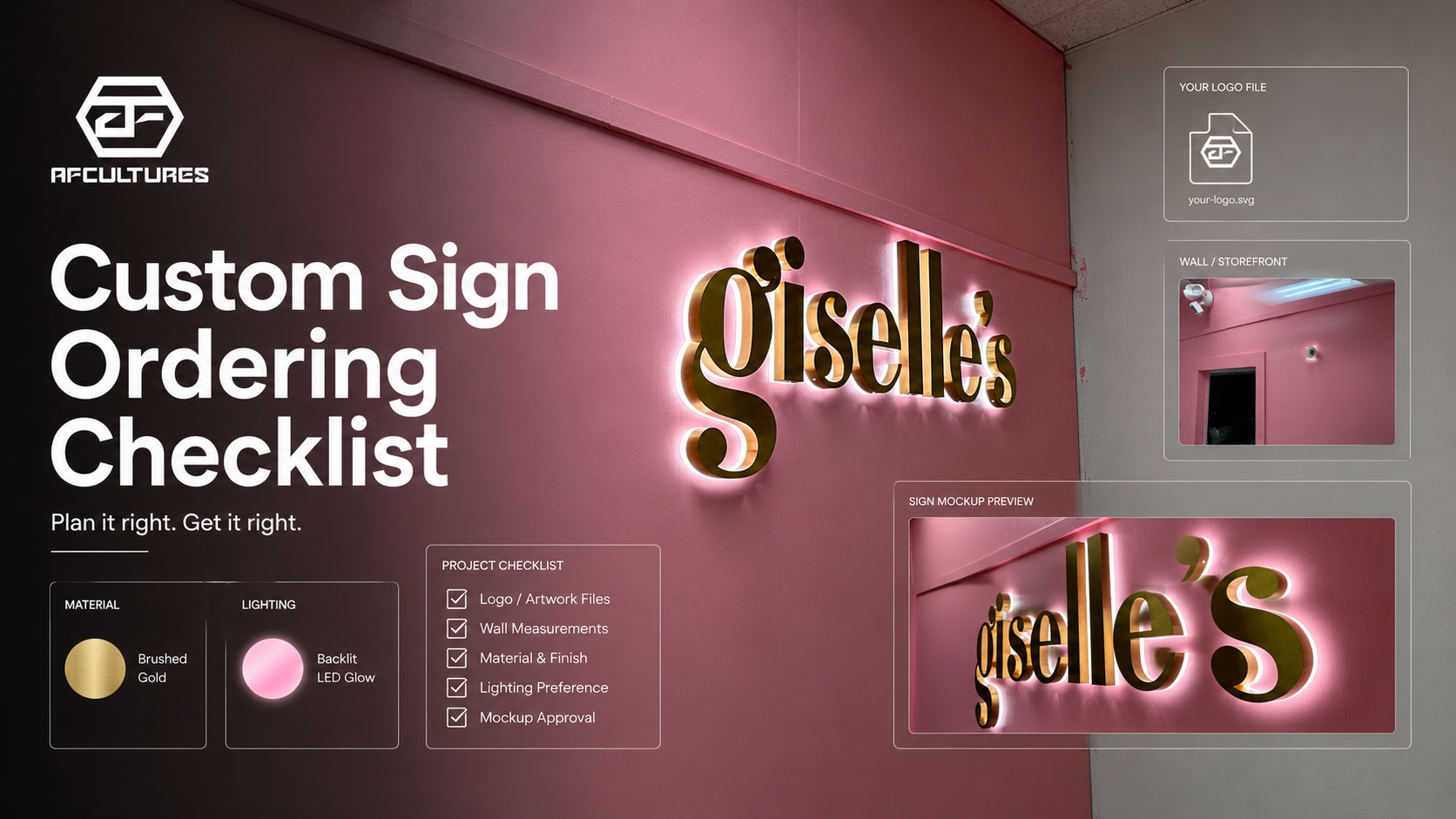
Before ordering a custom business sign, prepare:
-
Your logo file
-
A wall or storefront photo
-
Approximate sign size or wall width
-
Indoor or outdoor installation location
-
Preferred material or sign style, if you have one
-
Lighting preference
-
Project city/state
-
Desired timeline
-
Landlord or property requirements, if applicable
-
Budget range, if you have one
You do not need to have all the answers. But these details help the sign team understand the real space before production begins.

Plan The Sign Before You Build It
Avoid size, lighting, and installation mistakes before production starts. Send your logo, wall photo, and project location so AFCULTURES can help review what direction fits your space.
1. Your Logo File
Your logo is the starting point of the sign.
If possible, send a vector file such as AI, EPS, PDF, or SVG. Vector artwork is useful because it can be scaled for different sign sizes without losing quality.
If you only have a PNG or JPG, send the highest-resolution version available.
The sign team may need to check:
-
Letter thickness
-
Small details
-
Icon shape
-
Color accuracy
-
Taglines or secondary text
-
Whether the logo can be built clearly as a physical sign
A logo that looks good on a screen may still need adjustment before it becomes a sign. Thin strokes, tiny text, gradients, or very detailed icons can become difficult to read or fabricate at certain sizes.
This does not mean changing your brand. It means translating your brand into a buildable sign.
2. Wall Or Storefront Photo
A wall photo is one of the most useful things you can send.
A custom sign should not be planned in isolation. It has to work on the actual wall, storefront, lobby, reception area, or exterior surface.
Send photos that show:
-
The full wall or storefront
-
The area where the sign will go
-
Doors, windows, counters, furniture, or fixtures nearby
-
Wall texture and color
-
Existing lighting
-
Nearby power access, if visible
-
Any old signage that may need to be removed
A straight-on photo is helpful. A wider photo showing the full space is even better.
This helps the team check scale, placement, readability, and whether the sign will feel balanced in the real environment.

3. Approximate Size Or Wall Width
You do not need to know the exact final sign size yet.
But it helps to send the approximate wall width or the maximum area where the sign can go.
For example, you can share:
-
Wall width
-
Wall height
-
Preferred sign width
-
Distance from the floor
-
Distance from the ceiling
-
Width of the reception desk or storefront sign band
-
Any landlord or plaza size limits
Sign size should not be guessed from the logo alone. The Sign Research Foundation notes that viewing distance, size, and location are important factors when deciding sign placement.
It should be based on the viewing distance, wall proportion, and how people will actually see the sign.
A sign that is too small may feel weak. A sign that is too large may overpower the space or create installation issues.
4. Indoor Or Outdoor Location
Indoor and outdoor signs need different planning.
An indoor lobby sign may focus more on interior design, wall balance, finish, lighting mood, and photo-friendly brand presence.
An outdoor sign may need to consider weather exposure, visibility from the street, building surface, property rules, lighting, installation access, and local approval requirements.
Before ordering, clarify:
| Question | Why It Matters |
|---|---|
| Is the sign indoor or outdoor? | Affects material, lighting, mounting, and durability |
| Where exactly will it be installed? | Helps plan size, placement, and hardware |
| Will customers see it up close or from far away? | Affects readability and letter size |
| Will it need to be visible at night? | Affects lighting choice |
| Is landlord or city approval needed? | Can affect timeline and production decisions |
The location affects the build.
That is why a good custom sign quote should start with where the sign will live.
5. Material And Lighting Preference
You do not need to pick the final material by yourself.
But it helps to share the look you want.
For example:
-
Clean and modern
-
Premium and refined
-
Bold and high-impact
-
Warm and welcoming
-
Minimal and non-illuminated
-
Bright and visible at night
-
Metal, acrylic, LED, backlit, or dimensional
AFCULTURES offers options such as 3D LED signs, back-lit metal signs, and non-illuminated signs for different indoor and outdoor business needs.
Material and lighting affect not only appearance, but also cost, timeline, durability, installation, and long-term performance.
Lighting and location should be reviewed together because sign visibility can be affected by factors such as size, sign angle, location, luminance, and contrast.
If you are unsure, send a reference photo or describe the feeling you want. The team can help recommend a build direction based on your logo, location, budget, and timeline.
Not Sure Which Material Or Lighting Fits Your Sign?
AFCULTURES can review your logo, wall photo, installation location, and visibility needs before recommending material and lighting options.
6. Project Location And Timeline
Your project city, state, and timeline are important.
For outdoor signs, location can affect shipping, installation planning, local requirements, landlord approval, and permit considerations.
Your timeline also matters because custom signage usually includes several stages:
-
Design review
-
Mockup
-
Quote confirmation
-
Production
-
Quality check
-
Packing or shipping
-
Installation planning, if needed
If your sign is connected to a grand opening, renovation, event, lease deadline, or campaign launch, share that date early.
A realistic timeline helps avoid rushed decisions and last-minute production pressure.
7. Budget Range
Not every customer knows their exact budget.
That is okay.
But if you have a budget range, sharing it can help the sign team recommend a realistic solution.
A custom sign quote can vary based on:
-
Size
-
Material
-
Lighting
-
Design complexity
-
Indoor or outdoor use
-
Installation method
-
Shipping
-
Timeline
-
Permit or site requirements
A budget range does not mean lowering quality.
It helps the team recommend the best fit for your business goal instead of guessing.
Common Mistakes To Avoid Before Ordering
Before requesting a custom sign quote, avoid these mistakes:
-
Sending only a small logo screenshot
-
Not sharing the wall or storefront photo
-
Choosing a sign type before checking the real space
-
Forgetting to mention indoor vs outdoor use
-
Ignoring viewing distance
-
Waiting too long to mention a deadline
-
Asking for a final price before the scope is clear
-
Skipping landlord or property requirements for outdoor signs
Most sign problems do not start in fabrication.
They start when the project is quoted without enough information.
Ready To Start Your Custom Sign Project?
Send your logo, wall or storefront photo, project location, preferred timeline, and any sign ideas you already have. AFCULTURES can help turn your idea into a buildable sign direction before production begins.

Frequently Asked Questions
What files should I send for a custom sign quote?
Send a vector logo file if you have one, such as AI, EPS, PDF, or SVG. If not, send the highest-resolution PNG or JPG available. A wall or storefront photo is also very helpful.
Do I need to know the exact sign type before reaching out?
No. You do not need to know the exact sign type first. Send your logo, wall photo, installation location, and goal. The team can help recommend material, lighting, size, and build direction.
Why does a sign company need a wall or storefront photo?
A wall or storefront photo helps the sign team understand the real environment, including wall size, color, texture, viewing angle, lighting, doors, windows, and installation conditions.
What affects the cost of a custom sign?
Custom sign cost can depend on size, material, lighting, design complexity, indoor or outdoor use, installation method, shipping, timeline, and site or permit requirements.