


Channel Letters, Backlit Metal Signs, or Neon Flex: Which One Fits Your Space?
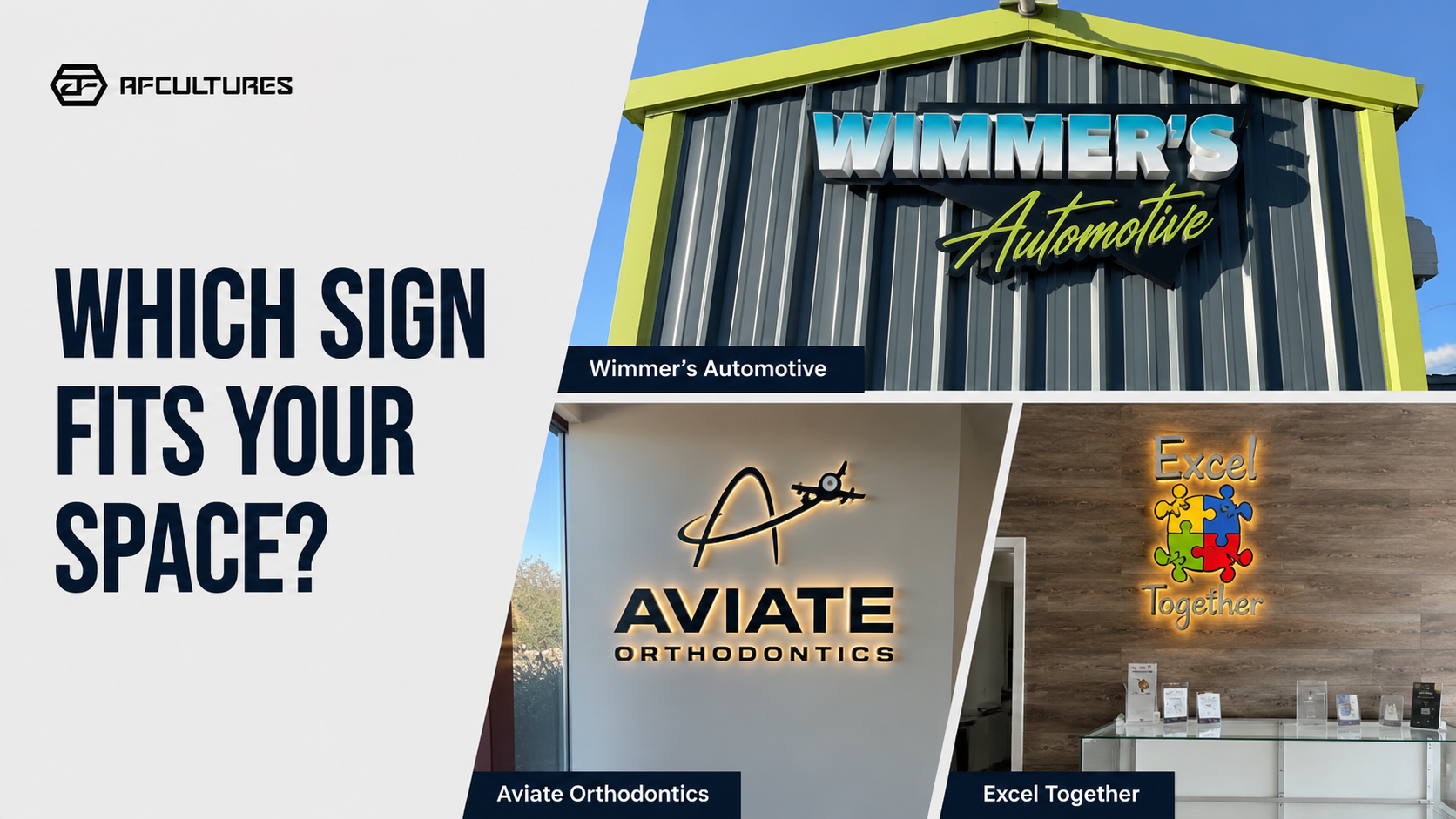
WHO SHOULD READ THIS
Business owners and designers choosing an illuminated sign for a storefront, lobby, restaurant, retail space, studio, or branded interior.
Quick Answer
Choose channel letters when the business name needs to be read clearly from a road, parking lot, or across a commercial property.
Choose a backlit metal sign when the logo needs more custom shape, dimensional depth, material character, and a controlled halo effect.
Choose Neon Flex when the goal is to create atmosphere, color, or an expressive indoor visual feature.
None of these options is automatically the best. The right choice depends on where the sign will go, how far away people will see it, whether it needs to work outdoors, what the wall allows, and what role the sign needs to play in the space.
The Difference at a Glance
| Factor | Channel Letters | Backlit Metal Signs | Neon Flex |
|---|---|---|---|
| Best location | Exterior storefronts | Interior or exterior, depending on construction | Primarily interior spaces |
| Main strength | Readability and visibility | Custom shape, depth, finish, and halo lighting | Atmosphere, color, and expressive linework |
| Lighting | Front-lit, halo-lit, or combination | LEDs positioned behind the metal form | Continuous flexible LED light |
| Logo flexibility | Best for clear letters and simplified forms | Strong for custom logos and dimensional designs | Best for bold, simplified outlines |
| Overall feel | Clear and commercial | Custom and substantial | Energetic and informal |
| Common use | Retail, restaurants, gyms, service businesses | Lobbies, showrooms, storefronts, branded walls | Studios, bars, events, restaurant interiors |
| Main limitation | Can feel standard without thoughtful design | Requires careful mounting and technical planning | Limited for detailed logos and long-distance readability |
Choose Channel Letters When Visibility Comes First
Channel letters are individual dimensional letters commonly used on commercial storefronts.
They can be front-lit, halo-lit, or illuminated in both directions. Their clear letter shapes and strong lighting make them useful when customers need to read the business name from the road, a parking lot, or another part of a shopping center.
They are a strong starting point when:
- The business name must remain clear from a distance
- The sign needs to work after dark
- The property already uses channel letters for neighboring tenants
- The landlord requires a conventional storefront system
Front lighting creates a brighter letter face. Halo lighting creates a softer glow around the letters.
For a closer comparison, review the differences between halo-lit and front-lit signs.
Channel letters are not automatically the right answer for every storefront. Frontage dimensions, viewing distance, mounting method, and landlord criteria should still be checked before the design is finalized.
 Channel letters prioritize clear storefront visibility when the business name needs to be read from a road or parking area
Choose a Backlit Metal Sign When the Logo Needs More Character
A backlit metal sign is a dimensional metal logo or set of letters with LEDs positioned behind the sign body.
The light reflects onto the wall, creating a controlled halo around the shape.
This direction offers more flexibility when the identity includes:
- A custom symbol
- Unusual letterforms
- Layered elements
- Distinctive metal finishes
- Multiple shapes that need to remain visually connected
Backlit metal signs can work well on lobby walls, showroom features, branded interiors, and storefronts that need to feel more specific to the business.
They also require more technical planning.
The wall material, sign depth, LED placement, wiring, mounting, shipping, installation, and future servicing all affect the final result.
You can review these details in our guide to how a 3D backlit metal sign works.

A backlit metal sign can preserve the logo’s custom shape while adding physical depth and a controlled halo effect
Choose Neon Flex When the Space Needs Atmosphere
Neon Flex uses flexible LED lighting to create a continuous, softer-looking line of light.
It is particularly effective when the sign is intended to become part of the atmosphere rather than carry the full responsibility of storefront identification.
Neon Flex can work well for:
- Restaurant and bar interiors
- Studios and content spaces
- Events
- Feature walls
- Photo moments
- Short phrases and simplified symbols
Its color and line-based appearance create an immediate visual effect.
However, very small details, tight curves, or complex logos may need to be simplified. It is also less suitable when the business name needs to be read clearly from a long distance.
For many businesses, Neon Flex works best as a supporting interior feature alongside a more permanent primary identity sign.
Which One Fits Your Situation?
| Your Priority | Start With |
|---|---|
| Be read clearly from the road | Channel letters |
| Preserve a custom logo shape | Backlit metal sign |
| Create an indoor visual moment | Neon Flex |
| Use the sign outdoors | Channel letters or an exterior-rated backlit metal sign |
| Add depth to a lobby or showroom wall | Backlit metal sign |
| Create a colorful secondary feature | Neon Flex |
| Work with an unusual wall or mounting surface | Start with the space before choosing the sign type |
A product image can look strong and still be wrong for the actual location.
The wall, viewing distance, nearby lighting, power access, installation conditions, and property requirements should influence the recommendation from the beginning.
Not sure which direction fits your space?
Send your logo, a clear wall photo, project location, and intended viewing distance. Those details are usually more useful than choosing a product name first.
What Should You Check Before Choosing?
Before approving a direction, confirm:
- Will the sign be installed indoors or outdoors?
- How far away will people need to read it?
- Does it need to work during the day, at night, or both?
- What is the wall made of?
- Is electrical access already available?
- Does the landlord restrict the sign type or mounting method?
- Must the finished sign preserve every detail of the original logo?
- Is this the main business sign or a supporting visual feature?
- Will the lighting components need to remain accessible for service?
If the wall, access, or viewing conditions are still unclear, read why a site survey matters before sign production.
Start With the Space, Not the Product
The strongest sign direction usually becomes clearer when the logo is placed into the real environment.
A practical process should:
- Visualize the logo on the actual wall
- Compare the most suitable illuminated sign directions
- Develop the scale, materials, lighting, and finish
- Check the mounting, wiring, and production requirements
- Approve a solution that can be built and installed properly
A custom logo may not fit neatly into a standard product category.
Its shape, colors, surrounding wall, viewing distance, and intended experience may lead to a more customized illuminated build.
The goal is not to force every logo into the same type of sign.
It is to find the option that helps the brand work best in its real space.

Custom logos may require a more flexible illuminated build based on their shape, colors, wall material, and role in the space
Frequently Asked Questions
Are channel letters the same as backlit metal signs?
Channel letters are a specific type of dimensional lettering. A backlit metal sign is a broader custom build that may include letters, symbols, connected logo shapes, or layered elements with LEDs positioned behind the metal form.
Is Neon Flex the same as a halo-lit sign?
No. Neon Flex produces a direct, continuous line of light. A halo-lit sign directs light toward the wall, creating a glow behind a dimensional letter or logo.
Can Neon Flex be used outdoors?
Some Neon Flex systems may be rated for exterior environments, but suitability depends on the product, electrical system, mounting, weather exposure, and local requirements. It is generally a stronger fit for controlled interior spaces.
Which option is easiest to maintain?
Maintenance depends on installation access, electrical layout, modular construction, and component placement, not only the sign type. Power supplies and lighting components should remain accessible whenever possible.
What should I send before asking for a recommendation?
Send a vector logo if available, a straight-on wall photo, approximate dimensions, the project city and state, indoor or outdoor use, intended viewing distance, and target timeline.
For a complete preparation list, review what to prepare before ordering a custom sign.
See the Right Direction Before You Build
Send AFCULTURES your logo and a photo of the space.
We will help you compare the most suitable illuminated sign directions, see how each option works on the real wall, and identify the practical details that need to be resolved before production.


