

Rebranding an Established Business? What Should Change in Your Signage, and What Should Stay?
WHO SHOULD READ THIS
Owners, marketing leaders, operations teams, and multi-location businesses with an established physical presence that are planning a rebrand, brand refresh, renovation, relocation, or signage update.
Quick Answer
Rebranding an established business does not mean replacing every sign with something completely different.
The better question is: Which parts of the physical brand still carry recognition, and which parts no longer represent the business you are today?
A useful planning sequence is: KEEP → UPDATE → REPOSITION → ROLLOUT
Keep the elements customers already recognize.
Update what no longer matches the brand.
Reconsider where the strongest brand moments belong.
Then create a system that can carry the refreshed identity across the rest of the business.
A Brand Refresh Should Start With an Audit, Not a New Sign
Established businesses have something new businesses do not:
Existing recognition.
Customers may already associate the company with a particular logo, color, storefront, entrance, reception wall, or other physical brand cue.
That recognition has value.
At the same time, the business may have changed significantly since the signage was originally installed.
The company may now be larger.
The customer experience may be more premium.
The space may have been renovated.
The business may have opened additional locations.
Or the visual identity may simply no longer reflect where the brand is going.
Before choosing a new sign, look at the existing physical brand as a system.
Ask: What is still working, and what is now holding the brand back?
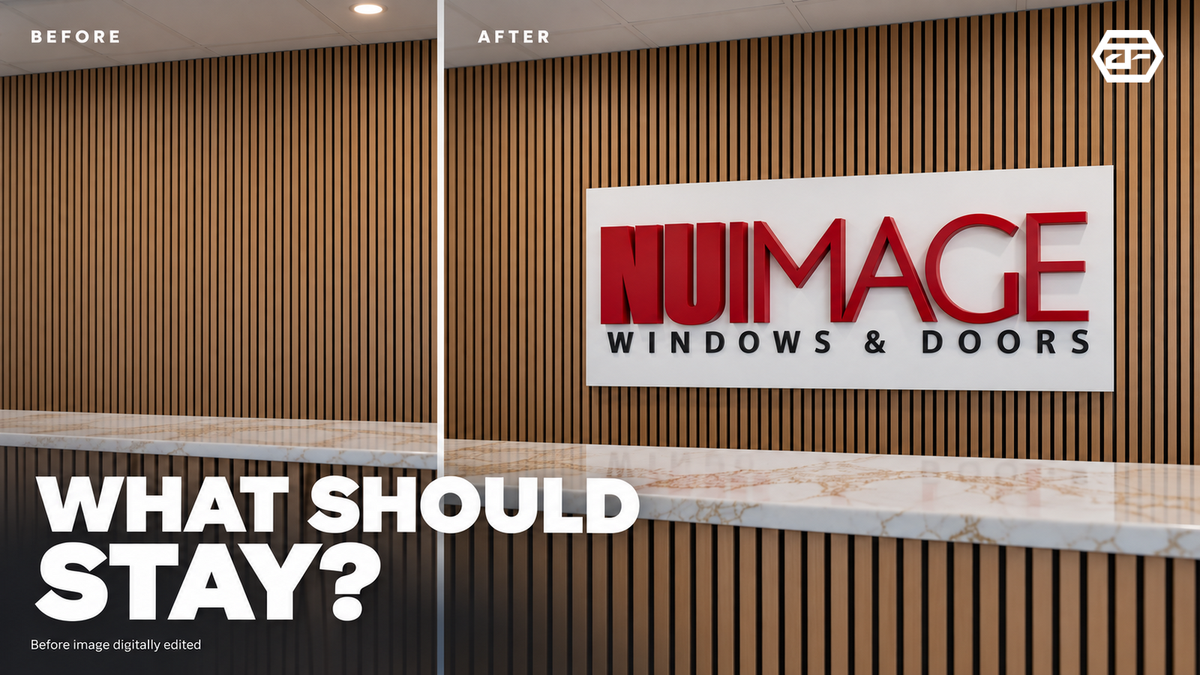
1. KEEP: Protect the Recognition You Have Already Built
A rebrand does not automatically require a complete visual reset.
Some existing elements may still be doing important work.
That could include:
- A recognizable wordmark
- A core color customers strongly associate with the business
- A storefront location customers already know
- A primary sign position that has strong visibility
- A familiar entrance or reception brand moment
The first step is to separate brand equity from brand habit.
An element should not stay simply because “we have always done it this way.”
But it should not disappear simply because something new feels more exciting.
If an existing sign location is already doing its job well, the smarter decision may be to improve what occupies that location rather than starting over somewhere else.
Updating an established brand but not sure what should stay?
Send AFCULTURES your current logo, updated brand files, and wide photos of the existing signage. We can help review which physical brand moments are worth keeping before you replace them.

An existing sign location may already carry valuable recognition. The first question is whether the location still works, not whether everything needs to start over.
2. UPDATE: Change What No Longer Represents the Business
A sign may still be functional while no longer being right for the brand.
This often becomes visible when the business itself has moved forward but the physical identity has not.
For example:
- The logo has changed but the location still carries the previous identity
- The business has become more premium while the signage still feels temporary
- The interior has been renovated but the main sign belongs to the old environment
- The company has grown but the signage still reflects a much smaller business
- Different locations have evolved in different visual directions
The goal is not simply to make the new sign look newer.
It is to make the physical environment communicate the same brand customers now encounter online, in marketing, and through the actual service experience.
Before approving the replacement, clarify what should be finalized before the sign moves forward so the refresh does not create another round of avoidable changes later.
3. REPOSITION: Do Not Assume the New Brand Belongs Where the Old Sign Was
Replacing an existing sign creates an easy assumption:
Put the new one in the same place.
Sometimes that is exactly right.
Sometimes it is not.
The business may have changed its entrance.
Customer traffic may now approach from a different direction.
The reception area may have been redesigned.
A new architectural feature may have become the stronger focal point.
Or the company may now need one clear brand anchor instead of several competing logo moments.
Before reusing the old location, look again at:
- Customer approach
- Entrance visibility
- Primary sightlines
- Reception or waiting areas
- Surrounding architecture
- Other signs already competing for attention
The refreshed brand deserves to be evaluated in the space as it exists now—not as it existed when the previous sign was installed.
This is especially important because a sign can look very different once it moves from an artwork file into a real environment. Our guide to why business signs can look different in reality explains why space and viewing context should be reviewed before final approval.

A refreshed identity should be reviewed in the space as it exists today, especially if the entrance, layout, or customer approach has changed.
4. ROLLOUT: Turn the Refresh Into a System, Not a Series of One-Off Replacements
The problem becomes larger when an established business has more than one location, department, office, or customer-facing space.
If every sign is updated independently, the refreshed brand can quickly become inconsistent again.
Instead, decide what should repeat.
That may include:
- Approved logo use
- Core visual hierarchy
- The role of the primary brand sign
- How secondary signs should support it
- What can adapt to different spaces
- Which reference location represents the brand best
The goal is not to make every sign identical.
It is to create enough structure that the brand remains recognizable as it moves across different physical environments.
The International Sign Association also frames on-premise signage as part of a business's broader marketing presence through its Signs for Marketing resource.
That is an important distinction for an established company:
The sign is not separate from the brand refresh. It is one of the places where customers experience whether the refresh actually feels real.
Refreshing the brand across more than one space?
Send us your current signage, new brand files, and photos of the locations being updated. AFCULTURES can help separate what should stay consistent from what should adapt before the rollout begins.
What Should Stay, and What Should Change?
| Consider Keeping | Consider Changing |
|---|---|
| Recognizable brand elements | Outdated identity elements |
| Strong existing sign locations | Poorly positioned brand moments |
| Useful customer-facing touchpoints | Signs with no clear role |
| Elements that still match the new brand | Visuals that no longer match the business |
| Proven location-level standards | Inconsistent one-off executions |
The answer is rarely “replace everything” or “keep everything.”
Usually, the stronger strategy sits somewhere between the two.
A 5-Question Signage Audit Before a Rebrand
Before replacing the existing signs, ask:
- Which physical brand elements do customers already recognize?
- Which signs no longer represent the business today?
- Are the strongest signs still in the right locations?
- What needs to stay consistent across different spaces or locations?
- What should the refreshed signage communicate that the old system did not?
If those questions are unanswered, choosing the new sign too early may solve the wrong problem.
Frequently Asked Questions
Should a business replace all of its signs during a rebrand?
Not necessarily. Start by auditing which signs, locations, and recognizable brand elements are still working. Some may be updated, some repositioned, and some replaced entirely.
Can a business keep its existing sign location after changing the brand?
Yes, if the location still works for visibility, customer approach, and the new space. But it should be reviewed again rather than assumed to be the best position simply because the previous sign was there.
What should we prepare before updating our business signage?
Prepare the current and new brand files, photos of existing signage, wide photos of the space, the locations being updated, any rollout priorities, and the target timeline.
A Strong Rebrand Does Not Erase Everything That Came Before
An established business already has recognition.
The signage refresh should use that advantage.
Keep what still carries value. Change what no longer represents the business. Reconsider the physical brand moments. Then create a system that can move forward with the company.
Rebranding, renovating, or updating an established business?
Send AFCULTURES your current signage photos, new brand files, key locations, and project timeline. We can help review what should stay, what should change, and how the refreshed identity should show up in the physical space.