

Home Service Company Signage: Does Your Office or Showroom Match the Brand Customers Already Know?

WHO SHOULD READ THIS
Owners, marketing leaders, and operations teams at established HVAC, electrical, plumbing, window and door, and other home service companies with a customer-facing office, showroom, warehouse, or headquarters.
Quick Answer
An established home service company should make its physical location feel as credible and recognizable as the brand customers already see on its vehicles, website, advertising, and service team.
The goal is not to put the logo on every available wall.
It is to make the customer-facing facility confirm the brand at the right moments.
A useful planning sequence is: APPROACH → CONFIRM → RECEIVE → REINFORCE
Help people recognize the business as they approach.
Confirm they have reached the right place.
Create a clear brand moment where customers or partners are received.
Then use supporting signage only where it adds something useful.
The Physical Location Can Fall Behind the Business
Established home service companies often grow in ways customers can easily see.
The fleet gets larger.
The website improves.
The team grows.
The company adds service areas, showrooms, departments, or new locations.
But the office or facility may still carry signage planned for an earlier version of the business.
That creates a mismatch.
A company may feel established everywhere else but look temporary, unclear, or underdeveloped when someone arrives at the physical location.
That matters most when the facility is used by customers, vendors, job candidates, commercial partners, or employees.
The signage should make the location feel like part of the same business they already know.
1. APPROACH: Can People Recognize the Company Before They Reach the Door?
Start outside.
Do not evaluate the primary sign only from directly in front of the building.
Look at the way people actually approach the property.
They may arrive from:
- A parking lot
- A shared commercial property
- A main road
- A side driveway
- A warehouse or industrial complex
- A neighboring suite or building entrance
The first signage question is simple: Can someone identify the company without having to search for it?
This does not automatically mean the sign needs to become larger.
Placement, surrounding architecture, competing information, and the normal viewing position all affect what people notice.
The International Sign Association's guidance on sign design and placement also emphasizes that visibility depends on how a sign is experienced in its environment, not simply on the sign viewed by itself.
If scale is part of the problem, it may also help to review how big a business sign should be for the way people actually view it.
 The primary exterior sign should be reviewed from the way customers actually approach the property, not only from directly in front of the building.
Not sure whether your office or showroom is easy to recognize?
Send AFCULTURES a wide exterior photo, your logo, and the normal customer approach. We can help review where the primary brand moment needs to work before you start replacing individual signs.
2. CONFIRM: Make the Right Location Obvious
Seeing the company name is not always the same as knowing where to go.
This becomes important when a home service company operates from a larger property with:
- Multiple doors
- Warehouse and office entrances
- A separate showroom
- Several suites
- Employee and customer entry points
- Delivery or service areas
The primary identity sign should establish the company.
Supporting information can then help people confirm the correct entrance or destination.
Do not force every message onto the main sign.
Hours, entrance instructions, department names, phone numbers, service lists, and operational information may be important, but not necessarily at the same moment.
A useful test is: Does the customer need this information to recognize the business, or only after they have already found it?
If it is needed later, it may belong closer to the point where the customer actually uses it.
Our guide to what information should go on a business sign covers the same distinction in more detail.
3. RECEIVE: Give Customers and Partners One Strong Brand Moment
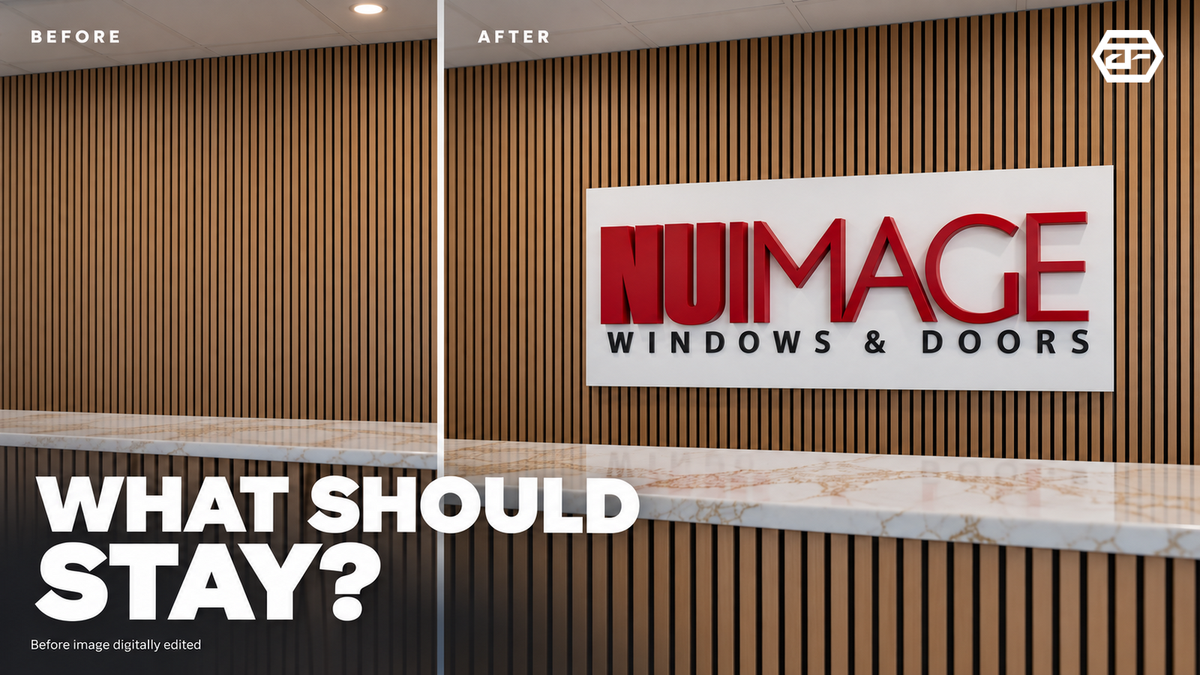
For companies with a showroom, reception area, customer counter, or corporate office, the branding job changes once someone enters.
The question is no longer: “Did I find the company?”
It becomes: “Does this place feel like the company I expected?”
This is where one strong interior brand anchor can do more than several weak logo placements.
Depending on the facility, that anchor might be:
- A reception wall
- A showroom focal point
- A customer waiting area
- A main office entrance
- A central employee-facing brand wall
The strongest location is not automatically the largest wall.
Choose the place that carries the most importance in the actual experience of the space.
A customer-facing facility should feel intentional, not like the brand stops at the front door.

Once customers enter, the signage job shifts from finding the company to reinforcing the quality and identity of the brand.
4. REINFORCE: Build a System Only Where the Facility Needs One
A larger home service company may need more than one sign.
But more signs should not mean more repetition.
Different touchpoints may have different jobs: IDENTIFY → CONFIRM → DIRECT → INFORM
The exterior identity establishes the company.
An entrance sign confirms the correct door.
A directional sign may guide visitors through a larger property.
An interior sign may reinforce the brand where customers, partners, or employees gather.
When those roles are planned together, the facility feels connected without requiring every sign to carry the same visual weight.
Planning signage across an office, showroom, or larger service facility?
Send us wide exterior and interior photos, your logo, and the main customer-facing areas. AFCULTURES can help map which moments need identity, confirmation, direction, or supporting branding before each sign is developed separately.
Where Should a Home Service Brand Spend the Most Attention?
| Touchpoint | Primary Job |
|---|---|
| Exterior identity | Make the company recognizable from the normal approach |
| Customer entrance | Confirm the correct place to enter |
| Reception or showroom | Create the strongest interior brand moment |
| Directional signs | Reduce uncertainty across a larger property |
| Supporting information | Provide details only when and where they are needed |
This hierarchy keeps the most important signs from competing with secondary information.
A 5-Question Facility Signage Check
Before replacing or adding signs, ask:
- Can customers recognize the company from the way they normally approach?
- Is the correct customer entrance obvious?
- Does the reception or showroom feel consistent with the brand?
- Are directional and informational signs solving a real problem?
- Does the facility look like the scale and quality of the business operating inside it?
If the last answer is no, the problem may be larger than one outdated sign.
Frequently Asked Questions
Does every home service company need a large exterior sign?
No. The right approach depends on the property, customer approach, visibility, and role of the location. A large sign in the wrong place may be less useful than a better-positioned primary identity.
Should an HVAC or plumbing company list all of its services on the main sign?
Usually the primary sign should first make the company easy to recognize. Service details can be placed elsewhere if customers only need that information after they have already found the business.
What should we send before planning signage for an office or showroom?
Start with your logo or brand files, a wide exterior photo, the normal customer approach, entrance photos, interior or showroom views, and any existing signs you are considering keeping or replacing.
Make the Facility Match the Business You Have Built
An established service company may already have a strong reputation, a recognizable fleet, a larger team, and years of customer trust.
The physical location should not feel like an afterthought.
Make the company easy to recognize. Make the entrance clear. Give the interior one strong brand moment. Then add supporting signs only where the space needs them.
Updating signage for an established home service company?
Send AFCULTURES your logo, exterior and interior photos, key customer-facing areas, existing signage, and project timeline. We can help turn the facility into a signage plan that better reflects the business you have built.