


What Is a 3D Backlit Metal Sign?
WHO SHOULD READ THIS
Business owners and designers considering a dimensional illuminated sign for a storefront, lobby, restaurant, showroom, or commercial space.
Quick Answer
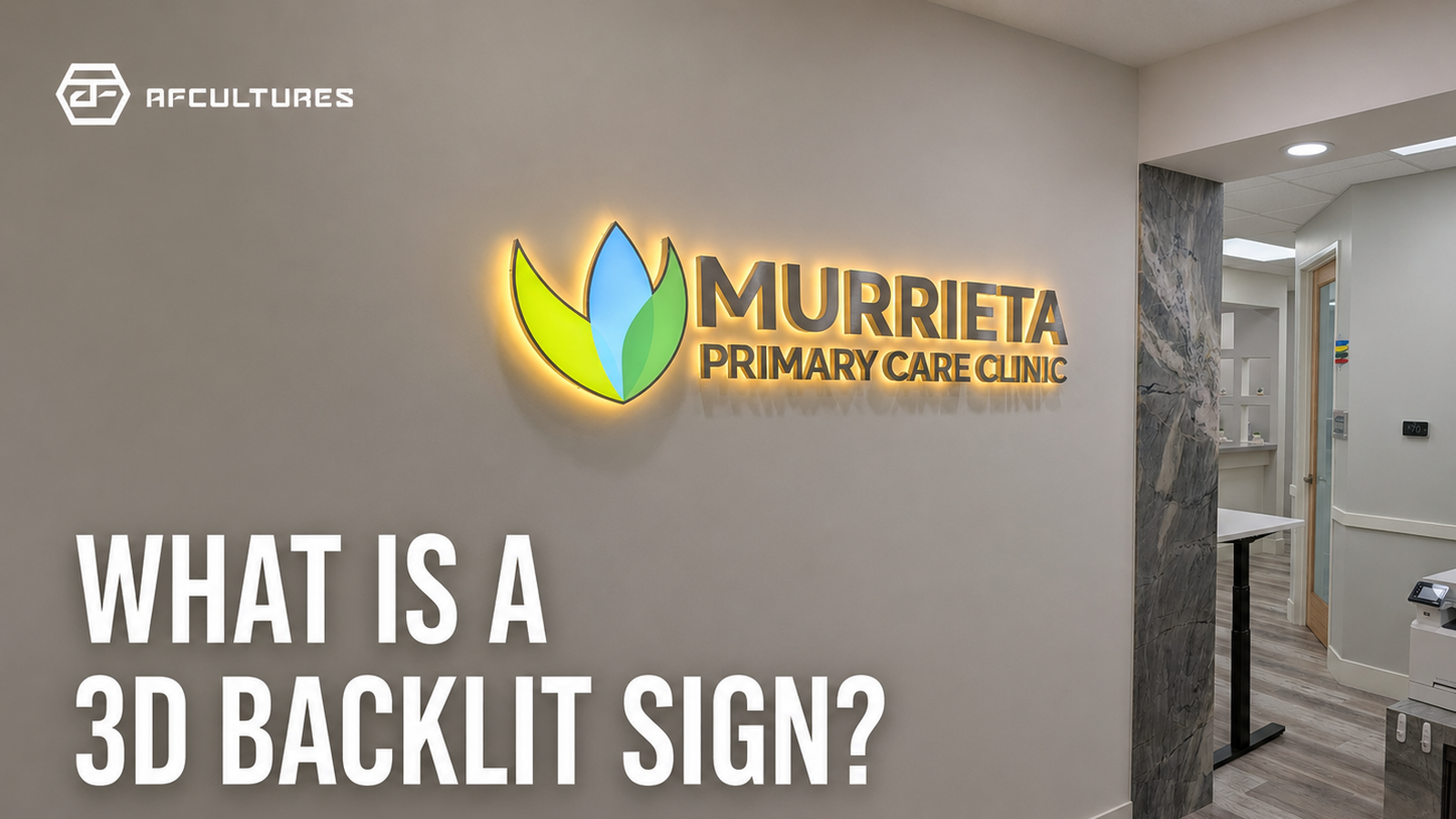
A 3D backlit metal sign is a dimensional metal logo or set of letters with LEDs positioned behind it. The light reflects onto the wall, creating a soft halo around the sign.
It works well when a business wants more depth, stronger nighttime visibility, and a sign that feels physically connected to the space.
Before production, however, you should review more than the front-facing mockup. Size, wall surface, lighting, depth, mounting, and wiring all affect the finished result.
How Does a 3D Backlit Sign Work?
Each letter or logo element is built as a three-dimensional form rather than a flat graphic.
The LEDs face backward toward the wall. When the light reflects from the surface, it creates the halo-lit effect.
This means the wall is part of the sign.
A smooth, light-colored wall may produce a wider and brighter glow. Dark, textured, wooden, stone, or slatted surfaces may change how evenly the light spreads.
That is why a sign should be planned on the actual wall-not approved only from a logo placed on a blank background.
If you are comparing different lighting directions, see the difference between halo-lit and front-lit signs
What Is the Sign Made Of?
| Component | Purpose |
|---|---|
| Face | The front surface of the logo or letters |
| Return | The side wall that gives the sign its depth |
| Backing | Supports the build and separates it from the wall |
| LED modules | Create the reflected halo |
| Power supply | Provides power to the lighting system |
| Mounting hardware | Secures the sign and controls its distance from the wall |

The face, return, backing, LEDs, and mounting system work together to create the finished sign.
The construction may change depending on whether the sign is installed indoors or outdoors, the type of wall, and the project’s electrical requirements. These site conditions are also why a site survey matters before sign production.
A realistic mockup shows how the sign may look.
A technical drawing or section view shows how it will actually be built.
Is a 3D Backlit Metal Sign Right for Your Space?
| Your Situation | Recommendation |
|---|---|
| You need the logo to remain visible after dark | Strong fit |
| You want a dimensional lobby focal point | Strong fit |
| Your wall has power access and a clean surface | Strong fit |
| Your logo contains very thin or detailed elements | Needs technical review |
| Your wall is heavily textured or uneven | Needs lighting testing |
| You need the lowest-cost signage option | Consider non-illuminated letters |
| You only need short-term promotional signage | Choose temporary graphics instead |

Wall color, texture, and spacing behind the sign can change how the halo appears.
A backlit sign is not automatically the best choice for every business.
The right option depends on the space, viewing conditions, budget, and how the sign will be used.
Planning a custom sign?
Send your logo and a clear photo of the wall. Reviewing both together makes it easier to evaluate scale, lighting, and installation before production.
What Should You Approve Before Production?
1. Size on the Real Wall
Review the sign in relation to doors, windows, furniture, wall edges, and the expected viewing distance.
A logo that looks balanced in a design file may feel too small or oversized once installed.
2. Metal Finish
Confirm the color and finish of both the face and the return.
The sides remain visible from an angle, so they should be treated as part of the design—not as an afterthought.
3. Lighting
Confirm whether the sign will use fixed white or RGB lighting.
Also review the intended color temperature and how it works with the wall, surrounding lights, and brand colors.
Brighter is not always better. The goal is an even halo without visible hot spots.
4. Depth and Wall Distance
The depth of the letters and their distance from the wall affect how the halo spreads.
These details also determine whether there is enough room for the LEDs, wiring, mounting hardware, and future maintenance.
5. Mounting and Wiring
Confirm:
- What the wall is made of
- How the sign will be secured
- Where the power comes from
- How the wiring will be hidden
- Whether the components remain accessible for service
These decisions should be resolved before fabrication begins.
From Logo to a Buildable Sign

A buildable sign connects the real space, visual direction, technical planning, and final production.
A good custom sign process should connect four stages:
- Visualize it on the actual wall.
- Develop the direction around the space, brand, and budget.
- Engineer the build, including lighting, structure, mounting, and wiring.
- Produce it for real use, considering shipping, installation, and future service.
The purpose is not simply to create a convincing image.
It is to make sure the approved design can become a sign that looks right, installs correctly, and continues to perform after it reaches the wall.
Frequently Asked Questions
Is a backlit sign the same as a halo-lit sign?
The terms are often used for the same lighting effect: LEDs shine toward the wall and create a halo behind dimensional letters or a logo.
Can it be used outdoors?
Yes, but the materials, finish, electrical components, mounting, and approvals must be appropriate for exterior use.
Does wall color affect the lighting?
Yes. Light, dark, glossy, and textured surfaces reflect light differently, which can change the brightness and shape of the halo.
What should I send to request a quote?
Send a vector logo if available, a clear wall photo, approximate dimensions, project location, indoor or outdoor use, and the target timeline. You can also review what to prepare before ordering a custom sign before submitting your project.
See Your Sign Before It Is Built
Send AFCULTURES your logo and a photo of the space.
We will help you evaluate the scale, lighting, material direction, and practical build requirements before the project enters production.


